Semantic Architecture for Agent-Ready Organizations (Allostasis AI)
An agent with a vision performs better
Everything valuable in an organization begins as leadership vision, and realizing it generates data objects everywhere: specs, code, pipelines, CRM records, support threads. Almost none of those objects were designed to carry the vision that produced them, so they drift: the same entity named three ways, definitions current in one system and stale in another, reasoning that lives in someone's head while the object records only the steps.
Humans absorb that drift with judgment. Agents can't. They act on the objects literally, at scale, and carry every ambiguity into every task downstream. The distance between what leadership means and what the objects say is the vision gap. Closing it is architecture work, not transcription work.
The AI acts on what you give it. Whatever your data does not say clearly, the AI will say for you.
Agent-readiness is a vision-fidelity problem, not a documentation problem
An agent-ready organization is built in process order: first the substrate agents read, then three decisions about how the work is organized, then the loop that proves the rest is working. Six layers, seven tests. Every test runs in-house, with the tools and access you already have.
- The legible substrate, covering vision & principles and vocabulary & contracts. Tested by
tradeoff-probeandten-term-diff - The knowledge graph as domain bounds, an explicit, versioned domain model wired in as the boundary of agent investigation. Tested by
traversal-probe - The deterministic boundary, separating tested machinery from model judgment. Tested by
misallocation-inventory - Workflows from observation, not the org chart, tested by
cold-start-run - A single owner of judgment, tested by
coherence-probe - Evals & feedback, tested by
silent-failure-probe
The framework, built
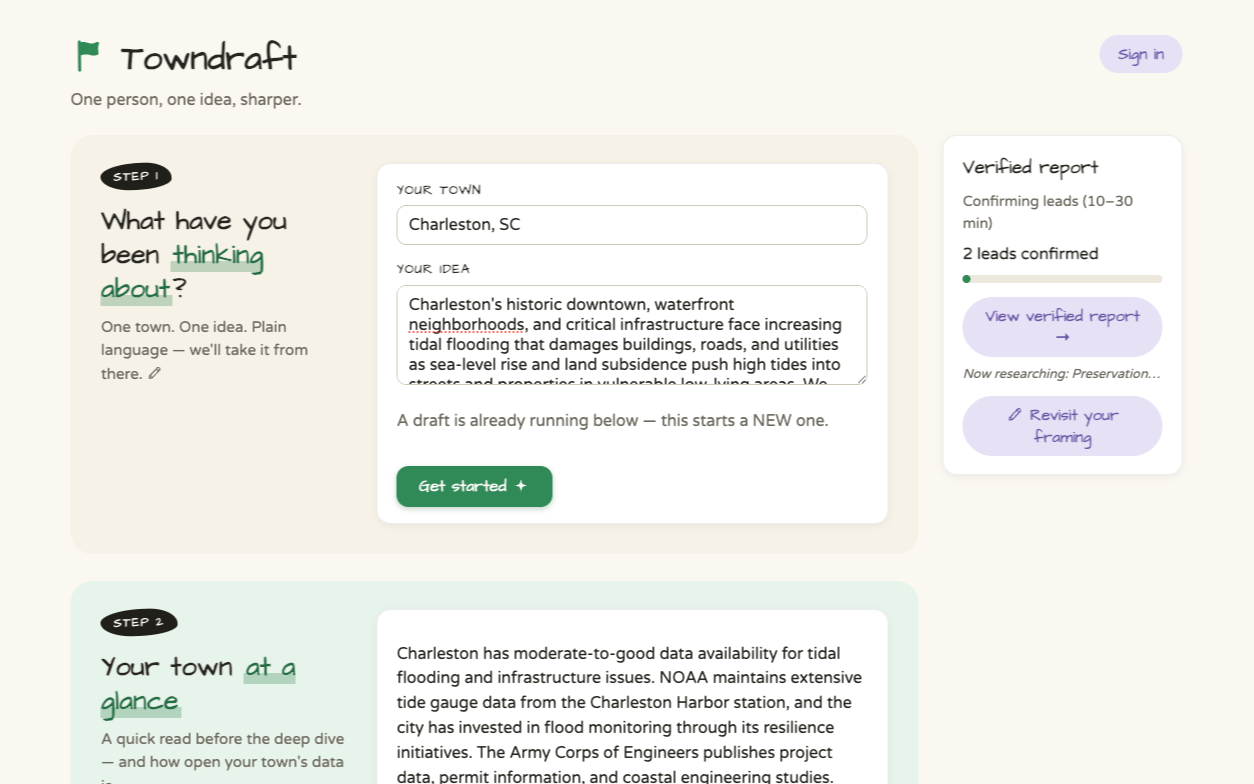
Towndraft is an agentic pipeline on FastAPI, Next.js, and Supabase with pgvector. Five stages run in sequence: staged retrieval, verified web research, knowledge-graph extraction and merge, ontology-typed gap-filling, and drafting.
The point worth making explicitly: the agents work from a versioned, entity-resolved knowledge graph, not from raw prompts. The graph is not one stage among five. It is the substrate every stage reads from and writes to. That is layer 02 of the field guide, shipped.
A framework nobody has built is a thesis. A framework running in production is a practice.
Agent-ready is measurable, not aspirational
Spec-driven development runs as standard practice: a project constitution agents read on every task, vertical-slice specs with acceptance criteria, and evals from the first agent run rather than after the first incident.
- A platform-neutral framework for agent-assisted code review, with capability-scoped agent charters, phase playbooks with explicit entry and exit criteria, and CI checks that block drift between spec and enforcement
- Prompt versioning and per-stage cost, latency, and degradation telemetry through W&B Weave
- Outcome and trajectory evals, so a regression is caught by instrumentation rather than by a user
Every stage is observable, every claim is checkable, and the interface surfaces its own progress and confidence rather than presenting a finished answer with no provenance.
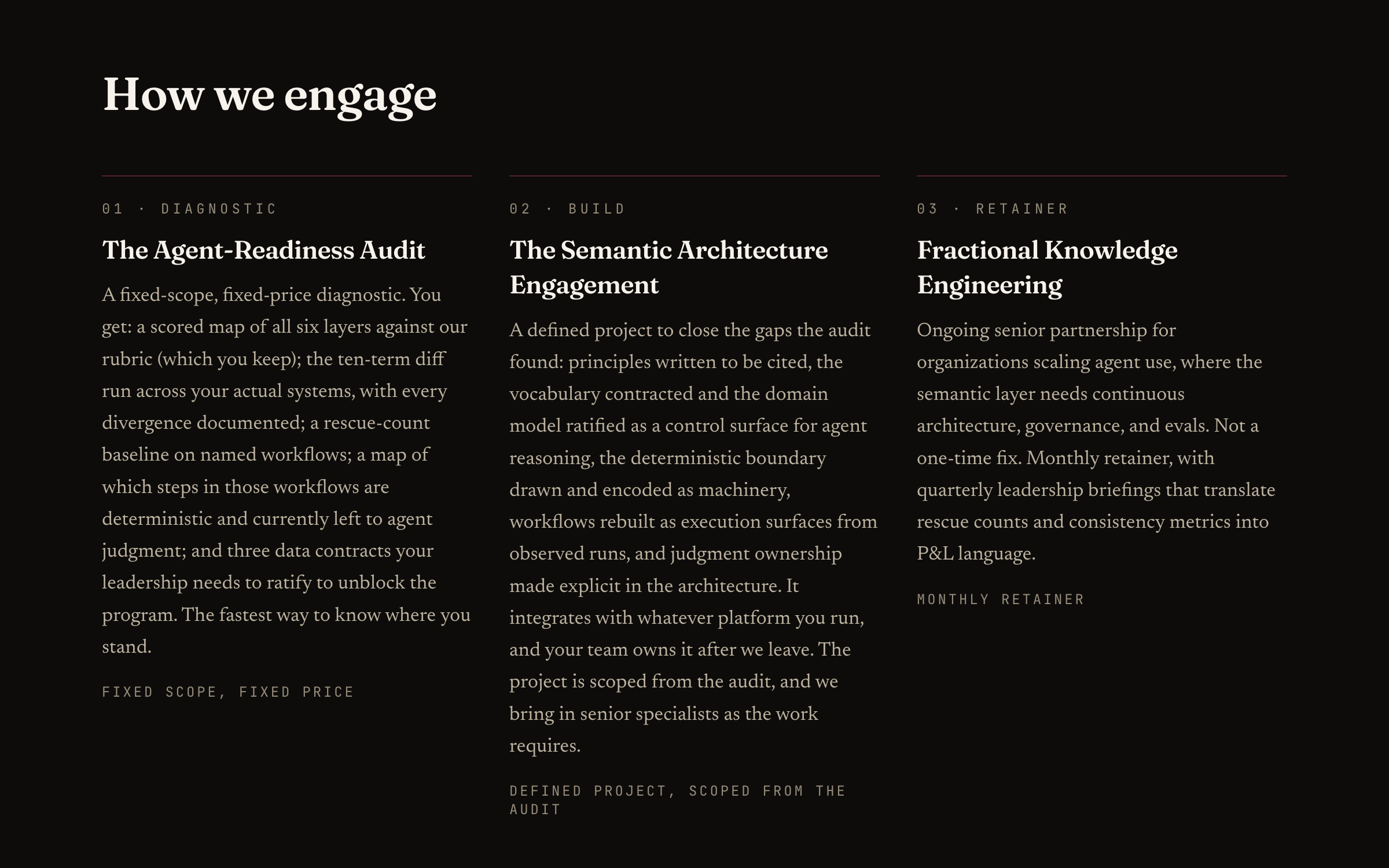
Three ways to engage
- The Agent-Readiness Audit, a fixed-scope, fixed-price diagnostic. You get a scored map of all six layers against our rubric (which you keep), the ten-term diff run across your actual systems, a rescue-count baseline on named workflows, a map of which steps in those workflows are deterministic and currently left to agent judgment, and three data contracts your leadership needs to ratify
- The Semantic Architecture Engagement, a defined project to close the gaps the audit found. It is scoped from the audit, on whatever platform you already run
- Fractional Knowledge Engineering, a monthly retainer for organizations scaling agent use, where the semantic layer needs continuous architecture, governance, and evals
This is not a pivot. Multi-axis metadata at Adobe let a customer land on exactly the right API for their language and their tools. A naming convention at Planet kept satellite imagery identifiable from the ground station all the way to the analyst’s workbench. The first developer documentation at Geospan gave a new engineering team a surface it could maintain itself. Same problem each time. Making meaning survive contact with the systems that carry it.
allostasis: stability through change